“Water-blocked” tells a buyer something about the cable’s design. The test report tells the buyer which construction was tested, under what conditions, and what the lab observed. When a tender calls for a longitudinal water penetration test, ask for those details before accepting a statement that says only “Pass.”
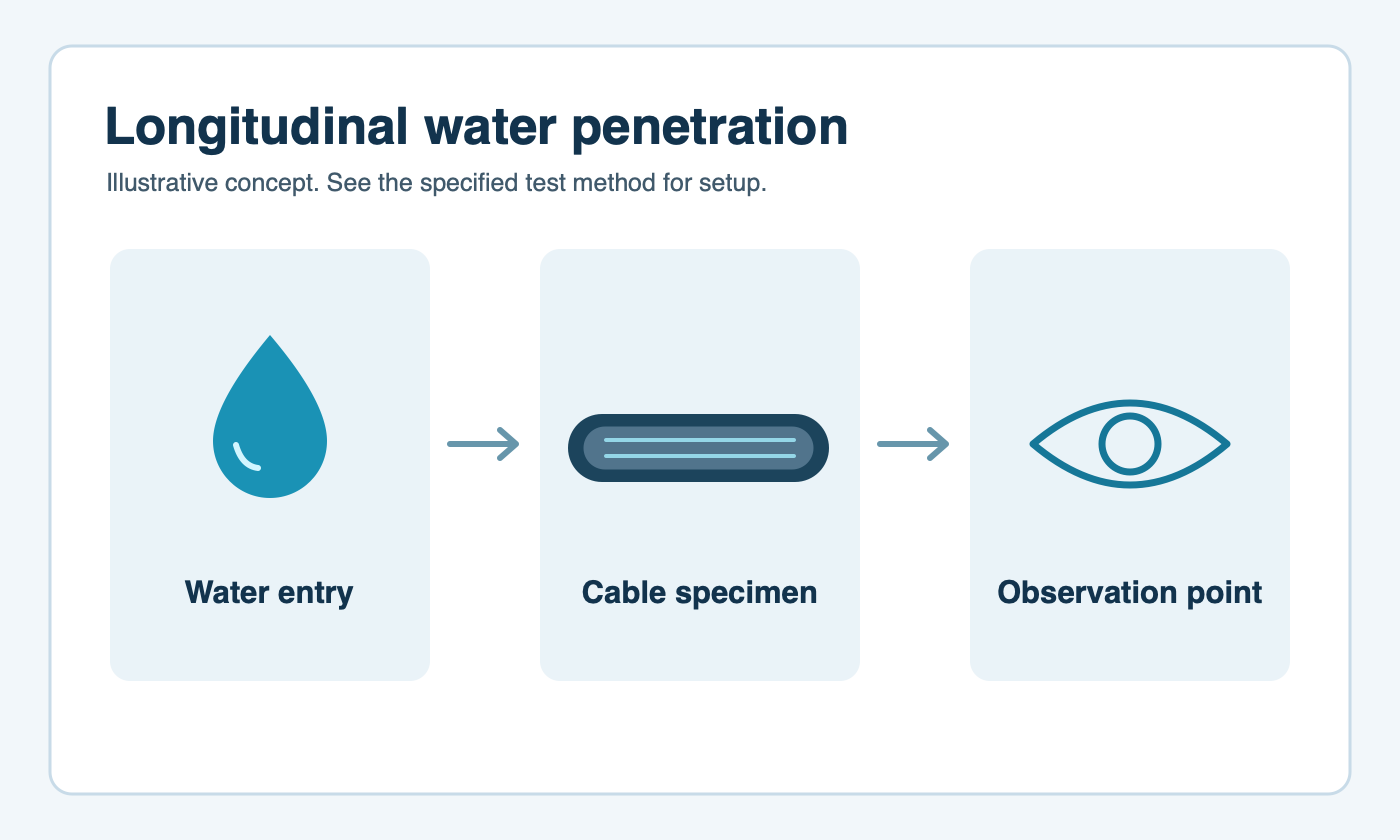
Longitudinal water penetration concerns movement along the cable over a specified test length after water is introduced in the way defined by the method. The outcome applies to the specimen and setup documented in the report. Jacket moisture permeation, cable resistance to hydrostatic pressure, and the sealing of a field-installed closure are separate questions. ITU-T duct and tunnel cable recommendation.
Begin with the tender’s test reference
In the ITU-T recommendation for duct and tunnel applications, the appropriate F5B or F5C arrangement depends on the cable design. Procurement documents may cite a specific IEC 60794 part and edition. Copy the actual contract citation into the inspection plan, including the method variant and the acceptance condition. If the report uses a different edition or arrangement, ask the project QA reviewer to determine whether the evidence is acceptable. An abbreviation alone does not settle equivalence. ITU-T L.100, environmental characteristics.
The requirement should also make clear when evidence is due. A design qualification report can support a construction if the proposed cable is within the approved scope. If the contract requires lot-based inspection, ask for the sampling or traceability evidence called for in the inspection plan.
Five things to find on the report
| Field | What to look for | Why it matters |
|---|---|---|
| Specimen identification | Cable code, construction or drawing revision, relevant fiber count, sample or lot ID | Connects the report to the construction under review |
| Method and edition | Full test reference and method variant, plus any recorded deviations | Makes the setup comparable with the contract |
| Sample preparation | Specimen length, water entry location and the cable region exposed | Defines what path the test actually challenged |
| Exposure conditions | Water head or applied pressure as specified, duration and other conditions required by the method | Shows whether the lab applied the agreed test conditions |
| Result and traceability | Observation at the specified point, pass/fail criterion, report number and date | Lets a reviewer reproduce the acceptance decision from the record |
If the document identifies only a product family, ask the supplier to map the test sample to the ordered construction. A different jacket, tube arrangement or water-blocking layer may matter to that decision. The reviewer should see the basis for applying the report to the order, including any approved extension of scope.
What if one offer uses gel and the other is dry?
Both approaches use materials to restrict water movement, but the labels do not identify every layer. A design can have filling compound in a tube and dry water-blocking materials elsewhere. Ask the supplier to mark the tested layers on the construction drawing and provide the report that corresponds to that build. Then compare the report with the project requirement.
Consider a hypothetical tender that names an armored duct cable and requires a longitudinal water test. One bidder offers a report for a cable with a similar model name but no sample drawing. The useful follow-up is to request the tested construction and a written link between it and the quoted revision. The name alone leaves an evidence gap. For the material choices themselves, see Gel-Filled vs Dry Water-Blocked Fiber Cable.
Keep installation acceptance separate
A satisfactory lab result can support the cable’s documented performance under the agreed test. It does not certify a buried route, cable entry or field-installed closure. If the installation needs sealed transitions or specified closure protection, state who supplies, installs and checks those interfaces. Include the approved route conditions and protection measures in the project documentation. Ebocom direct burial guide.
What should I request before approving the cable? Ask for the named method and edition, the approved drawing with revision, a specimen identifier tied to that drawing, the setup and exposure details, and the final leakage observation against the specified limit. Add the lot evidence only when the purchase specification calls for it. Send the proposed cable and document requirements to Ebocom for a project-specific response.