Technical Guide
ADSS (all-dielectric self-supporting) and OPGW (optical ground wire) cables both carry optical fibers along overhead power lines, but they do very different jobs on the tower. OPGW replaces the earth wire at the top of the structure and becomes part of the line’s lightning and fault-current protection. ADSS is a fully non-metallic cable hung below the phase conductors and has no electrical function at all.
Choosing between them is usually decided by the project itself: whether the line is new or already energized, its voltage, whether an outage is possible and what the existing structures can carry. This guide explains the differences and the information a supplier needs to quote either cable.
What is OPGW cable?
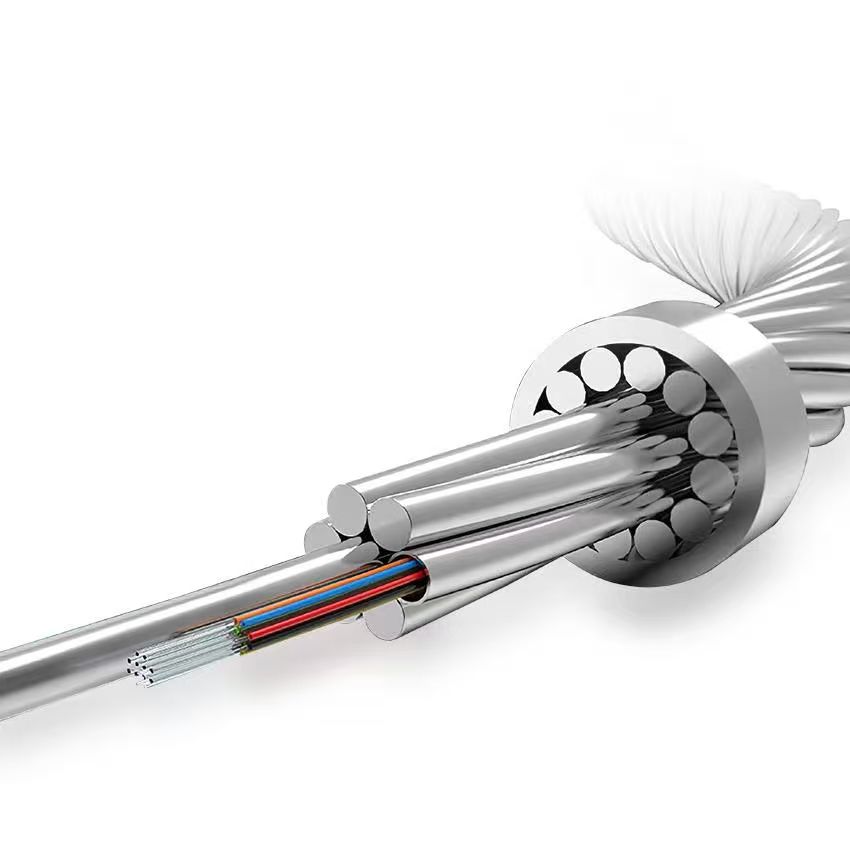
OPGW combines two functions in one conductor. Optical fibers are protected inside a stainless steel tube, which is surrounded by layers of aluminum-clad steel and/or aluminum alloy wires. The metallic layers give the cable its mechanical strength and allow it to work as the line’s shield wire, conducting lightning strikes and short-circuit currents to ground.
Because OPGW sits in the earth-wire position, it is normally installed when a new transmission line is built or when an existing earth wire is being replaced. That work generally requires the line to be taken out of service. OPGW must be designed to match the line’s electrical requirements, in particular its short-circuit current rating, as well as the sag and tension of the original earth wire.
What is ADSS cable?
ADSS uses no metal. Fibers sit in loose tubes, aramid yarns provide the tensile strength and the cable is finished with a polyethylene (PE) or anti-tracking (AT) outer sheath. Because it is dielectric, ADSS can be installed on existing towers and poles below the conductors, often while the line remains energized.
The amount of aramid is designed for the route’s span lengths, sag limits and wind and ice loading, so the same fiber count can be made in several span ratings. On higher-voltage lines, where the cable sits in a stronger electric field, an anti-tracking sheath is used to resist dry-band arcing. For more detail on span ratings, see our guide to specifying ADSS span before requesting a quote.
ADSS vs OPGW: side-by-side comparison
| Factor | ADSS | OPGW |
|---|---|---|
| Construction | All dielectric: loose tubes, aramid yarn, PE or AT sheath | Stainless steel fiber tube with aluminum-clad steel / aluminum alloy wires |
| Position on the structure | Below the phase conductors | Top of the structure, in the earth-wire position |
| Electrical role | None | Shield wire: carries lightning and fault current |
| Typical projects | Adding fiber to existing distribution and transmission lines | New transmission lines or earth-wire replacement |
| Line outage | Often installed with the line energized | Usually requires an outage |
| Key design inputs | Span schedule, sag, wind/ice loading, electric field at the attachment point | Short-circuit current, lightning performance, sag-tension matched to the line |
| Relative cost | Lower cable and installation cost on existing lines | Higher cable cost, but replaces the earth wire it is installed in place of |
How to choose: four practical questions
- Is the line new or already in service? New transmission lines and earth-wire replacement projects usually specify OPGW. Adding fiber to a line that is already energized is usually an ADSS job.
- Can the line be taken out of service? If no outage is available, ADSS is normally the only practical option.
- What voltage is the line? OPGW is standard on high-voltage transmission lines. ADSS is widely used on distribution lines and is also used on transmission lines when the electric field at the attachment point allows it, with an AT sheath where required.
- What can the structures carry? ADSS adds load and needs clearance below the conductors, so tower or pole capacity and ground clearance must be checked by the line designer.
On some routes both cables are used: OPGW on the high-voltage backbone and ADSS on lower-voltage branches or where an existing line is being upgraded.
What to send for a quotation
Whichever cable you need, a complete enquiry lets the supplier confirm the design instead of guessing. Mark any item you do not know yet so it can be agreed during the technical discussion.
- Cable type (ADSS or OPGW), fiber count, fiber type and total length.
- Line voltage and project location.
- For ADSS: span schedule or maximum span, sag limit, wind and ice conditions, and whether an AT sheath is required.
- For OPGW: short-circuit current and duration, the earth wire being replaced and the required sag-tension values.
- Applicable standard or tender specification, drum length and destination port.
Get a quotation from Ebocom
Ebocom manufactures ADSS and OPGW cable at its own plant in Jinan, China. Every drum is tested before shipment and the test report is included with the delivery. Browse our ADSS cable range and OPGW cable range, then send us your route details or message us on WhatsApp. We reply with a full quotation and datasheet within 12 hours.