
Technical Guide
FTTH drop cable selection starts with the installation route, followed by the required fiber count and construction. An indoor run, an unsupported aerial section and an underground duct place different requirements on the finished cable.
A route sketch can show the path from the distribution point to the subscriber, including weather-exposed sections, spans between supports, ducts and the building entrance. That description gives a supplier more to work with than “one-core FTTH cable” alone.
FTTH drop cable selection by route
Our FTTH catalog lists indoor drop cables, outdoor self-supporting drop cables and duct drop cables. These are starting points for selection; the approved specification for the exact model must establish where it can be used.
| Route section | Candidate to discuss | Checks before ordering |
|---|---|---|
| Indoor routing to the subscriber outlet | Indoor drop cable, such as the catalog’s GJXH/GJXFH families | Required jacket and fire performance, dimensions, bend limits and termination method |
| Aerial connection to a building | Self-supporting drop cable, such as GJYXCH/GJYXFCH | Span and loading conditions, messenger construction, fittings and outdoor suitability |
| Installation through a duct | A duct-designated drop construction, such as GJYXH03/GJYXFH03 | Duct route, water exposure, installation method, pulling limits and outside dimensions |
The model families above are catalog references, not automatic approvals for every site. Specify the required construction and performance instead of relying on a model code by itself.
For aerial drops, check what supports the cable
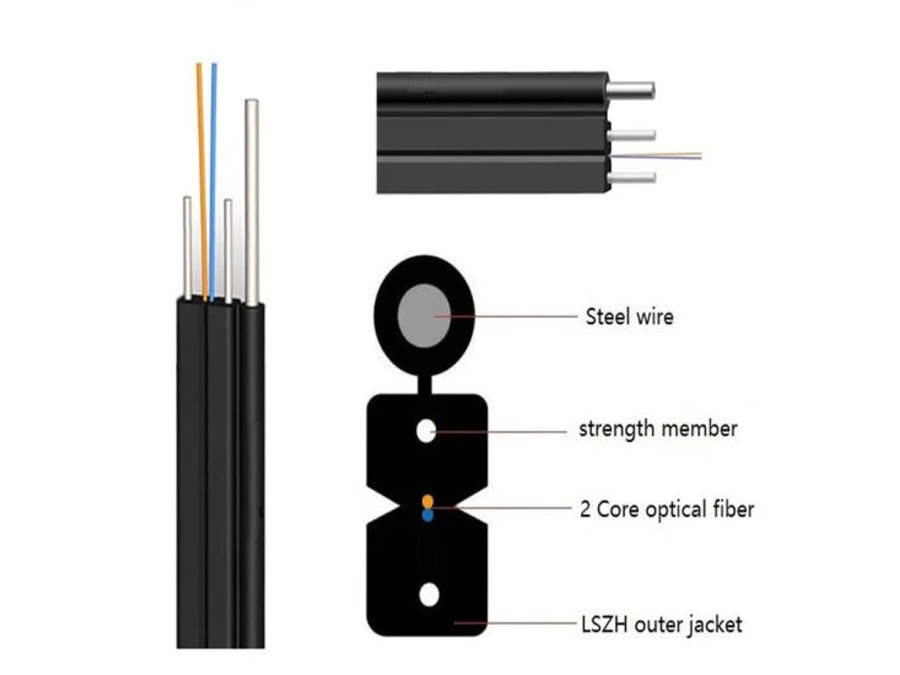
The self-supporting butterfly-style drop cable illustrated in Ebocom’s catalog includes a separate steel messenger alongside the optical cable section. The indoor version does not have that separate messenger. Both may include parallel strength members, depending on the specified construction.
These details matter when requesting compatible attachments and planning the route. Tell the supplier whether the cable crosses an open span or is continuously supported along a wall. Provide the span and environmental requirements for an aerial section, and request the relevant mechanical limits and hardware information.
Do not assume that a cable is entirely nonmetallic because its optical section uses FRP strength members. Check the whole cross-section, including any messenger, and have the installation designer address metallic components where relevant.
An outdoor self-supporting drop cable project in Southeast Asia
For an ISP project in Southeast Asia, we supplied outdoor self-supporting FTTH drop cables in 1-core and 4-core G657A configurations, produced and tested at our Jinan factory. Our Southeast Asia FTTH project note describes that order.
The order is a concrete example of the aerial-drop product family. For another route, the required fiber count, construction and installation conditions still form the basis of the selection.
Separate fiber bend performance from cable handling limits
ITU-T G.657 addresses bending-loss-insensitive single-mode optical fiber and cable. Where a project calls for a G.657 category, specify the exact category in the inquiry rather than writing only “bend-insensitive fiber.”
The finished cable still has handling limits. Ask for the manufacturer’s minimum bend radius during installation and after installation, together with the permitted pulling load. The FOA installation guide emphasizes following the cable manufacturer’s recommendations and avoiding excessive tension or tight bends.
For a flat drop cable, request clear handling instructions for its shape and routing direction. Check the outlet box and planned corners against those instructions. A fiber designation should not be used as permission to fold or sharply kink the complete cable.
Treat the building entrance as a selection checkpoint
The building entrance is a point where cable requirements may change. The project designer can establish whether the proposed outdoor cable may continue inside or whether the route needs a transition to another construction.
Ebocom’s catalog lists LSZH and PVC jacket options for certain drop-cable families. Confirm the material and the required fire-performance documentation for the exact product. An LSZH description alone does not establish every classification a building project may require.
Similarly, a duct route should be described as a duct route. If part of the cable will be directly buried, state that separately and request a construction specifically evaluated for that use. Do not extend a duct application claim to direct burial without supporting confirmation.
Include termination and packaging in the inquiry
The termination format belongs in the purchase description: unterminated cable or a preterminated assembly. For an assembly, the connector interface, polish type, end configuration and required length define what the supplier needs to check for scope and compatibility.
For bulk cable, provide the preferred reel length and packing requirements. For either format, include the planned acceptance checks and the product identification you need on labels or packaging. This keeps the purchase description tied to how the installer will receive and use the product.
A short checklist for your FTTH cable request
- Route description: indoor, wall-mounted outdoor, aerial, duct, or a combination.
- Fiber count and exact fiber specification.
- For aerial sections: span, exposure conditions and support arrangement.
- For duct sections: route details, installation method and environmental requirements.
- Jacket requirements and project-specific fire-performance documentation.
- Required cable dimensions, bend limits and mechanical limits.
- Termination method, reel or assembly lengths, quantity and packing.
Explore Ebocom’s FTTH cable range and send your route sketch with the checklist. Describe any section whose requirements are still undecided so the product discussion can focus on the remaining selection questions.