
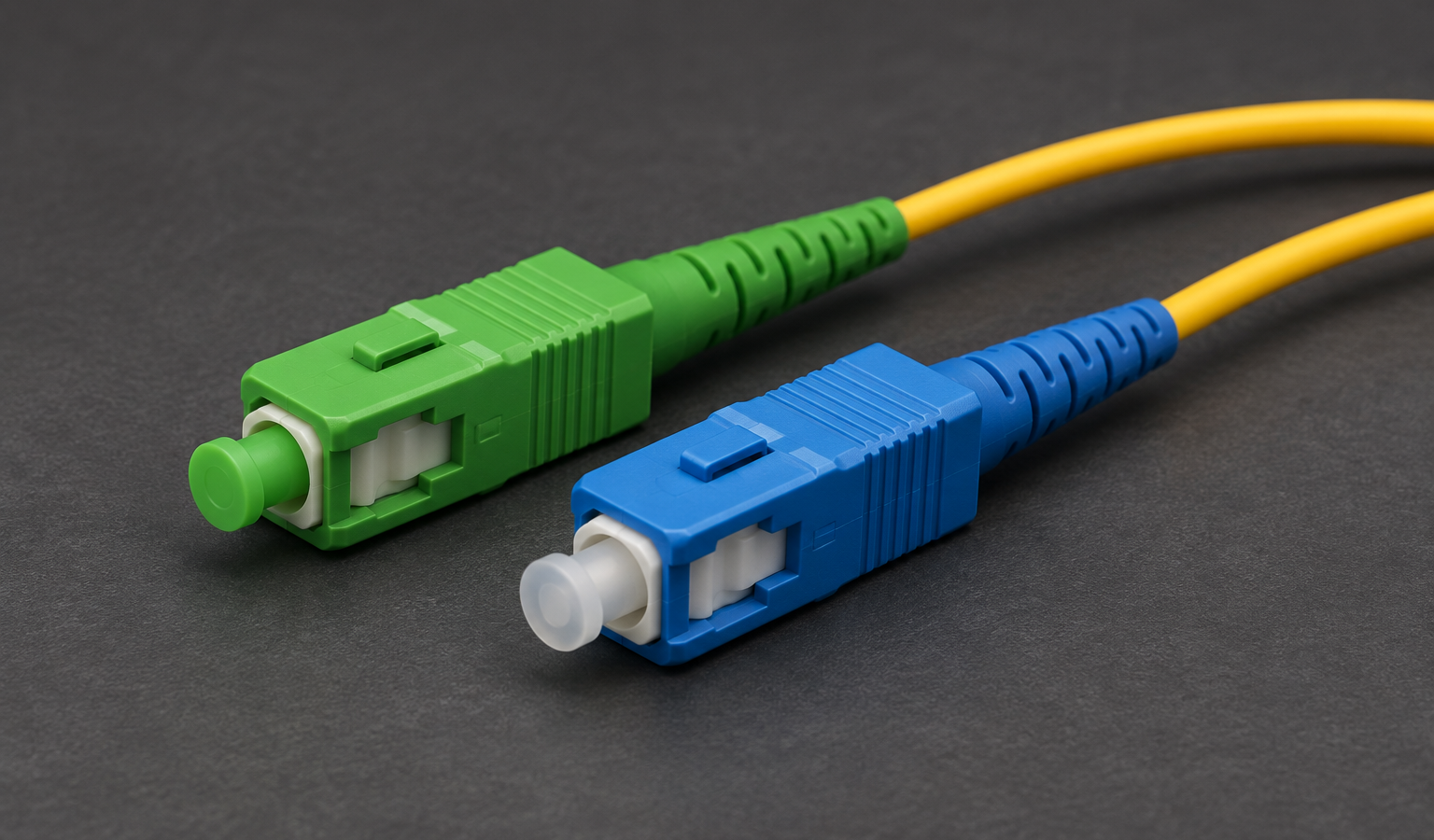
AI-generated product illustration; not a photograph of an Ebocom product or a guide to identifying an unmarked connector.
SC/APC vs SC/UPC is a compatibility decision before it is a price comparison. Both connectors use the SC housing format, but their polished end faces are different. Match the polish at each physical connection. Do not push an APC connector into a UPC connection simply because the housing fits.
That distinction also explains something that can look contradictory in a catalogue: a patch cord may have APC at one end and UPC at the other. The two ends are not mating with each other. Each must match the port it reaches.
SC/APC vs SC/UPC: what actually changes?
APC means angled physical contact. UPC means ultra physical contact. APC uses an angled end face, commonly 8 degrees, to reduce light reflected back toward the source. UPC uses a non-angled, curved physical-contact finish. Green normally identifies single-mode APC connectors; blue normally identifies single-mode UPC. Use those colours as a quick visual check, then read the connector designation and equipment documentation.
Corning describes the geometry of its 8-degree APC connectors. Belden’s APC and UPC comparison warns against mating the two finishes: poor contact can impair performance and damage the connectors. Neither source says that every application should be converted to APC.
| Question | SC/APC | SC/UPC |
|---|---|---|
| What must the mating interface accept? | SC/APC | SC/UPC |
| Usual single-mode identification | Green housing or boot | Blue housing or boot |
| What needs separate checking? | Insertion loss, return loss, fibre and assembly details | The same items; the polish name is not a complete specification |
An APC-to-UPC cord is not an APC-to-UPC mating
Consider a hypothetical connection between a distribution panel documented as SC/APC and a device documented as SC/UPC. An assembly specified as SC/APC at End A and SC/UPC at End B can match those two interfaces. At the panel, APC meets APC. At the device, UPC meets UPC. The cable between them does not change that rule.
Now change the scenario: both panel and device require SC/APC, but the storekeeper substitutes a cord with one blue SC/UPC end. That replacement creates a mismatch at one end. Buying an adapter with a different coloured housing does not repolish the ferrule or make the incorrect connection acceptable.
For a rack with ten identical connections, record ten complete End A/End B pairs. Do not order “ten SC leads” and leave the two ends to interpretation. Mark the destination of each end on the drawing or packing schedule. This is an illustrative ordering example, not a report of an Ebocom customer installation.
Read the loss figures without reversing the meaning
Insertion loss describes power lost through the connection; lower is generally preferable within the specified test conditions. Return loss describes how little light comes back; a larger positive return-loss number means less reflection. Reflectance is usually expressed as a negative number, where a more negative value means less reflected power.
For example, −50 dB reflectance corresponds to 50 dB return loss for that same reflected-power ratio. The FOA explanation of reflectance also distinguishes an individual reflection from an instrument’s whole-link optical return-loss result. Keep the metric, sign and measurement scope on the comparison sheet. Do not compare a connector value with a complete-link result as if they were interchangeable.
Ebocom’s pre-connectorized FTTH drop cable page lists SC/UPC and SC/APC options, insertion loss of ≤0.3 dB, and return loss of ≥50 dB for UPC or ≥60 dB for APC. Those are the published product figures, not a universal acceptance rule for every network. Match the quoted assembly and its test record to the selected option.
SC/APC vs SC/UPC at the test instrument
The test port deserves its own entry on the connection drawing. Fluke Networks describes a specific case in its APC testing guidance: the CertiFiber Pro input can accept APC in a non-contact arrangement, while its output uses UPC. That instrument-specific detail is a reason to read the manual, not permission to mix polishes at ordinary physical-contact joints.
Keep the reference leads identified with the instrument and test procedure. A passing result obtained with an undocumented setup is harder to reproduce later. For the separate question of total link loss versus locating individual events, use Ebocom’s OTDR vs OLTS guide.
Make the two ends visible in the order
A useful purchase line reads: “End A: SC/APC; End B: SC/UPC; single-mode fibre category: [specified grade]; finished length: [required length]; jacket: [required material]; quantity: [number]; loss requirements and test record: [project requirement].” The bracketed fields are for the buyer to complete, not suggested product values.
Attach the port schedule when requesting an Ebocom quotation, or email leo@yibocable.com. Identify both ends before the price is compared. Your spec, quoted in 12 hours.