
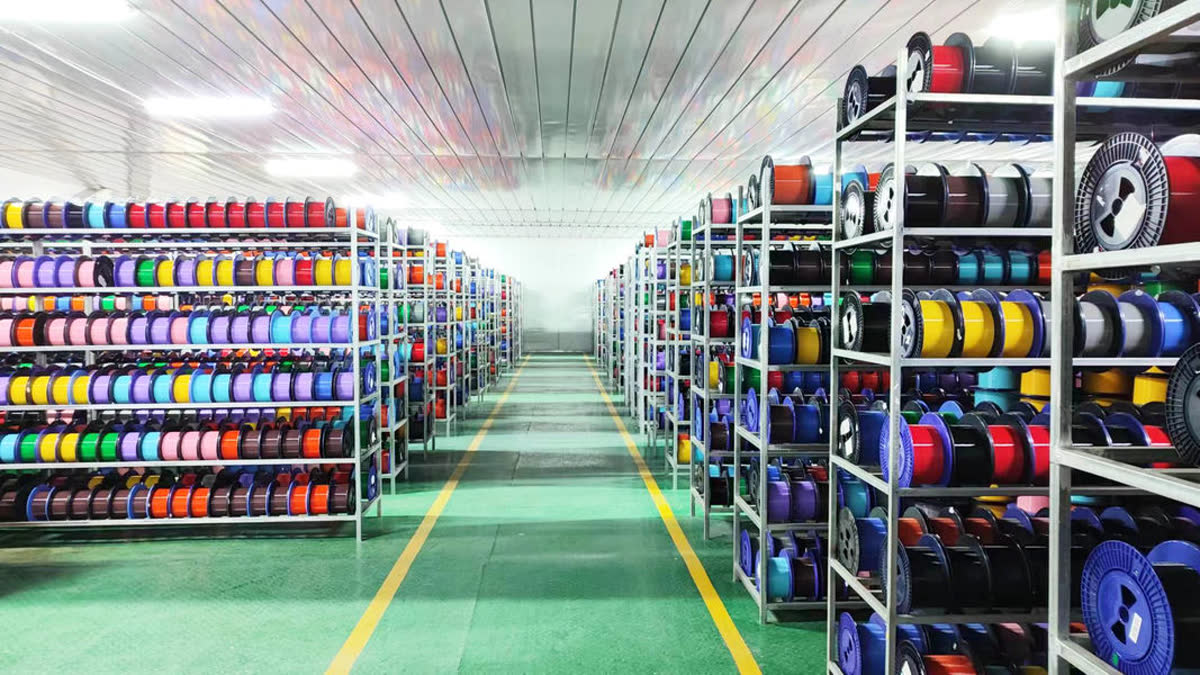
Fiber storage at Ebocom. Archive photograph of conventional manufacturing stock.
On November 12, 2026, the Fiber Broadband Association announced a Technology Committee paper examining how operators might get more out of limited fiber routes. One of the technologies it highlights, multicore fiber, puts several light-guiding cores inside the cladding of a single fiber. The association points to links between data centers and to submarine systems as potential uses where space carries a premium. Read the FBA announcement.
The distinction matters to anyone reading a cable schedule. An operator ordering an ordinary “48-core” cable typically expects 48 individual fibers. A technician can identify each by tube and color and route it into a splice tray. In the association’s paper, the word core takes the reader one layer deeper, inside an individual strand of glass.
What changes when cores share the glass?
Imagine two drawings on a tender desk. In the first, an enlarged cross-section shows four separate fibers, each with a single core and its own cladding. In the second, four cores sit inside one common cladding. Both drawings contain four cores, but they call for different connections at the ends. ITU’s technical report on space division multiplexing describes how multicore fiber designs can vary in core spacing and layout. A count alone leaves that geometry unspecified. See section 6.1.2 of the ITU report.
For a buyer facing a full duct, the first question is where the constraint sits. If it is on a short crossing between buildings, mark that section and its endpoints before comparing proposals. A specialty-fiber proposal should show how each optical path connects to the equipment on either side. For a conventional cable proposal, ask for the outside diameter and the number of separately identifiable fibers. Those details let the project team compare what fits in the duct and what it can actually connect at each end.
The FBA paper also covers hollow-core fiber, distributed sensing and fiber-to-the-room. Each addresses a different engineering problem. For the association’s account of where they may be useful, read The Future of Fiber Technology: What’s Next? For an example of how a conventional cable is recorded on a splice drawing, see Ebocom’s 48-fiber color-code guide.