
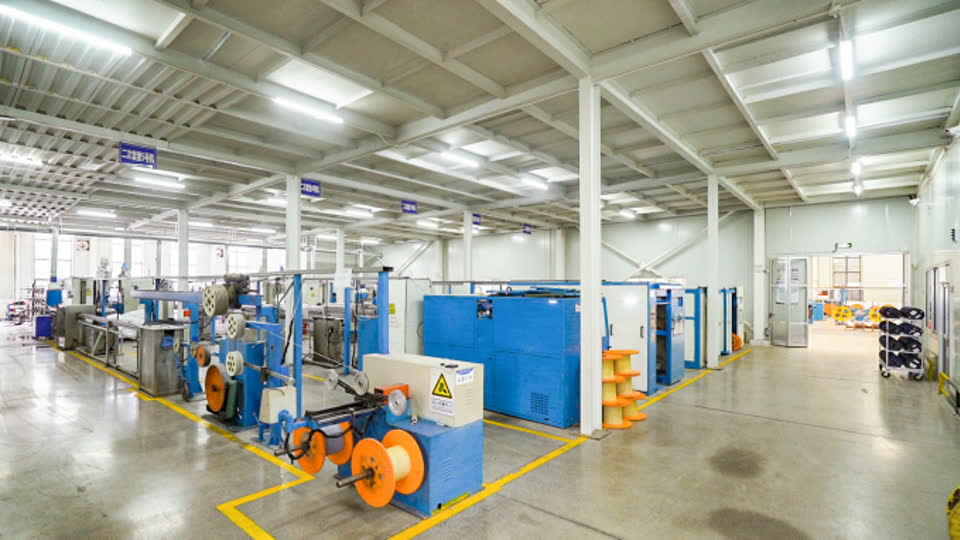
Loose-tube production equipment at Ebocom.
Two suppliers offer a 12-fiber single-mode cable. One drawing shows twelve fibers sharing a tube. The other shows a protective buffer around each fiber. Both quotations can have the right fiber count and still leave the installer with very different jobs at the patch panel.
For a duct between buildings where the fibers will be spliced in trays, start with an outdoor-rated loose-tube design. For a dry run inside a building where individual fibers will be handled in a panel, start with tight-buffered distribution cable. The decision turns on two things you can mark on a drawing: where the jacket will be exposed and what happens to each fiber after the jacket ends.
Loose tube vs tight buffer at the cable end
Open a loose-tube cable and the first unit you handle may be a tube containing several coated fibers. The tube gives the fibers room to move. Once it is removed, the installer needs a protected path for the individual fibers into a splice tray or a compatible termination kit. A tight-buffered cable adds a layer directly around each coated fiber. That makes an individual fiber easier to handle on its way to a connector. The Fiber Optic Association’s cable guide illustrates both constructions.
| What to look for | Loose tube | Tight-buffered distribution |
|---|---|---|
| On the cross-section | How many tubes? How many fibers share each tube? | What is the diameter over the buffer on each fiber? |
| At the panel | Where does the tube stop, and where do the exposed fibers enter a tray or fan-out? | Does the connector accept that buffer size, and how is the cable anchored? |
| On the quote | Check whether pigtails, trays and any fan-out kit are included. | Check whether the price covers field connectors or a splice-and-pigtail termination. |
What 0.9 mm means on an Ebocom drawing
Ebocom’s GJFJV indoor cable lists a 0.9 mm tight buffer. That dimension belongs to one buffered fiber. If a contractor asks whether the cable fits a gland, the figure they need is the outside diameter of the complete cable for the chosen fiber count. If they ask whether it fits a field connector, the 0.9 mm figure becomes relevant. One dimension cannot answer both questions.
Compare that with Ebocom’s GYFXTY outdoor cable. Its drawing describes a central gel-filled tube and two parallel FRP strength members. All three details matter at the enclosure. The crew needs to know which component enters the tray, what holds the cable in place and how the gel-filled tube will be prepared. A change in those details can change the termination materials on the order even when the glass type stays the same.
A building entrance can change the order
Suppose a campus link crosses an outdoor duct, enters a basement and continues to a rack on the third floor. Mark the entrance point and the proposed splice location separately. If the plan calls for a transition in the basement, quote the outdoor cable to that location, the indoor cable onward, and the enclosure between them. If the designer wants one continuous cable, request the exact model’s environmental and building-use ratings for the whole route.
A tight buffer alone tells you little about a jacket’s suitability for a wet duct. Likewise, an outdoor cable’s water-blocking construction does not establish its suitability for a vertical run inside a building. Check the jacket marking and the documents required for the installation location before agreeing to either substitution.
Compare the price per finished link
Ask both bidders to price the same endpoints. For example, twelve fibers spliced to individual pigtails at both ends require 24 pigtails and 24 splices if every fiber is terminated. A quotation for the bare cable excludes that work unless the scope says otherwise. If six fibers will be left dark and un-terminated, say which six. The installer can then size the trays and identify the spare fibers without guessing what “12-fiber link” means.
One useful check on a revised quote is to circle every component that crosses the handover point. If the cable supplier stops at the basement enclosure and the building contractor starts at the rack, neither price may include the indoor tail. Give that short section an owner and a length before comparing totals.
For an Ebocom quotation, mark the building entry and the two termination points on the route sketch. Include the connector or pigtail part number if it has already been selected. Send the sketch with your cable enquiry.