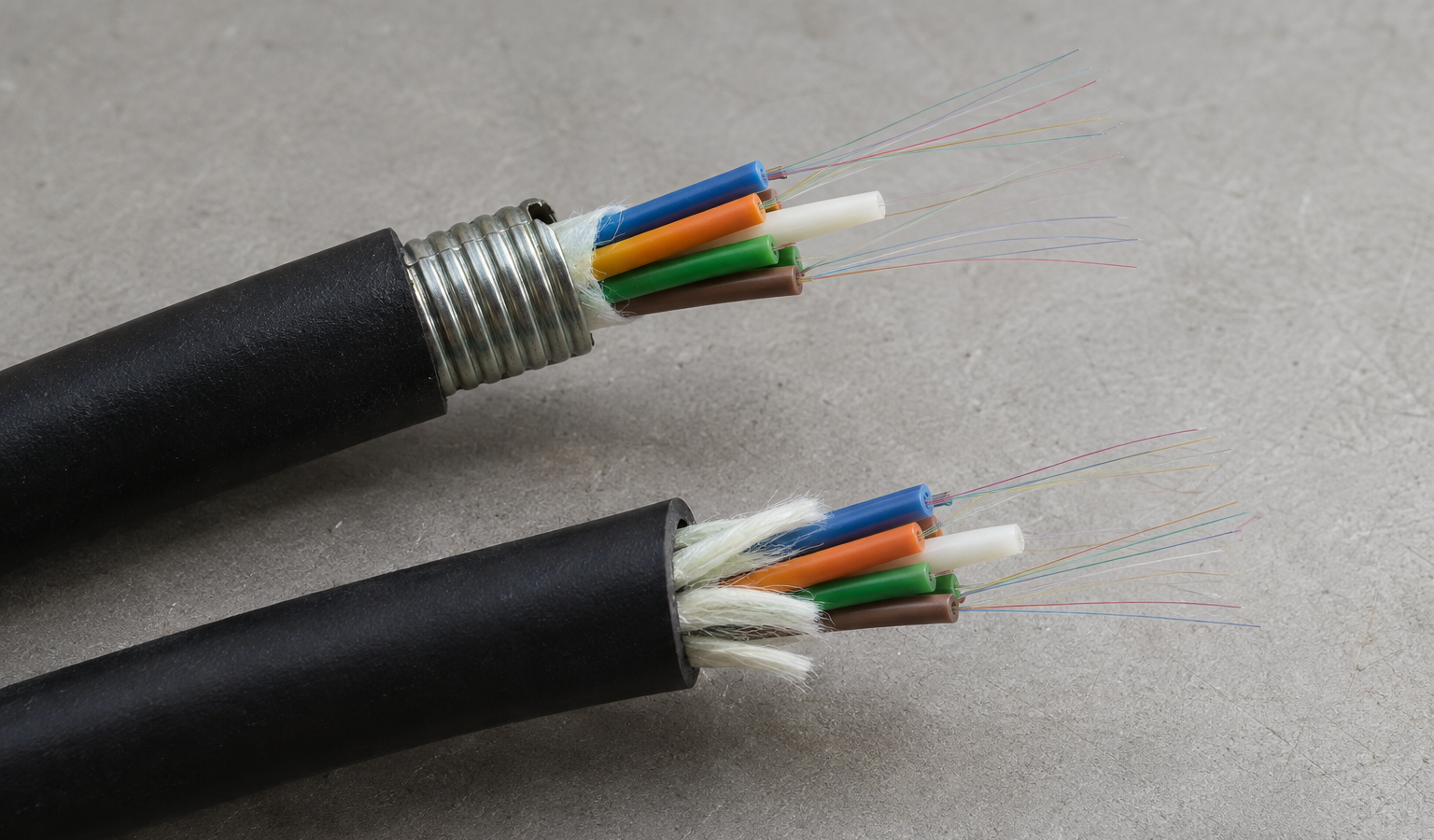
Cover image: AI-generated illustration of cable constructions, not an exact Ebocom product specification.
Armored vs non-armored fiber cable is not a choice to settle from a catalogue label alone. Start with where the cable will be installed, what it may encounter during installation and service, and what the project specification actually requires.
A cable that is suitable for one section of a route may be the wrong starting point for another. Direct burial, duct, aerial and indoor sections put the cable under different conditions. Before asking a supplier for a price, describe those sections separately.
What armor changes — and what it does not
Armor is an added protective construction feature. In outside-plant work, it can be relevant where the route calls for extra resistance to crushing or to damage from rodents. That does not make armor a universal upgrade. An armored construction can also introduce a conductive metallic layer, so grounding and bonding requirements need to be considered where they apply.
More importantly, armor does not decide the whole cable specification. It does not identify the fiber type, prove an installation method, set an approved pulling limit or replace a route drawing. The project requirement still has to state what is needed and how the cable will be evaluated.
Compare the installation conditions first
| Question to resolve | Why it changes the discussion | What to provide in the RFQ |
|---|---|---|
| Where is each section installed? | A direct-buried section, a duct run and an aerial segment do not face the same installation conditions. | Route drawing or section schedule, including each transition. |
| What exposure is specified? | Mechanical exposure, soil or rock conditions, water exposure and rodent concerns must be described as project conditions, not assumed from a cable name. | Relevant project specification and any site constraints already known. |
| How will the cable be installed? | Pulling, placing and supporting are different operations. The installation method determines which cable data must be checked. | Installation method, continuous section lengths and proposed joint locations. |
| Are metallic components permitted? | Where a proposed construction contains conductive metal, the responsible project party should confirm applicable grounding and bonding requirements. | Applicable electrical, building or owner requirements. |
| What is included in supply? | Cable-only offers should not be compared as though they include the same fittings, documents, packaging or delivery scope. | A clear list of inclusions, exclusions and required documents. |
Use product pages to identify candidates, not to approve a route
Ebocom currently lists a GYTA53 direct-buried cable and an outdoor non-armored GYFTY cable. Those pages can help a buyer start a product conversation. They should not be read as a substitute for the approved design of a particular route.
For example, a buyer should not conclude that every direct-buried route needs the same construction, or that every non-armored outdoor cable belongs on the same kind of route. Put the route conditions beside the proposed construction and ask the responsible project party to resolve any open points before an order is released.
Put bids on one comparison sheet
Two offers with the same fiber count can still be materially different. Keep a side-by-side sheet with the exact fiber requirement, proposed construction, route section, installation limits, drum schedule, supplied accessories, document package and stated deviations. If a supplier offers an alternative, ask for the difference to be identified in writing rather than leaving it hidden in a model code.
This is especially useful when an armored option costs more. The useful question is not simply whether the price is higher. It is whether both quotations answer the same route, the same supply scope and the same acceptance requirements.
Questions to attach to an armored vs non-armored inquiry
- Which route sections are direct buried, duct, aerial, indoor or transitional?
- What fiber count and fiber specification are required?
- What mechanical, water-exposure or rodent conditions are stated in the project documents?
- How will each section be installed, and where are joints permitted?
- Are metallic components restricted, or are grounding and bonding requirements specified?
- Which construction, test or inspection documents are required for acceptance?
- What drum lengths, destination and delivery scope should the quotation cover?
For a broader route package, see the outdoor fiber optic cable route RFQ checklist. If your requirement is ready, send the route drawing, section schedule and project specification through Ebocom’s contact page. Your spec, quoted in 12 hours.
Technical reference: FOA: Outside Plant Fiber Optic Cable.