
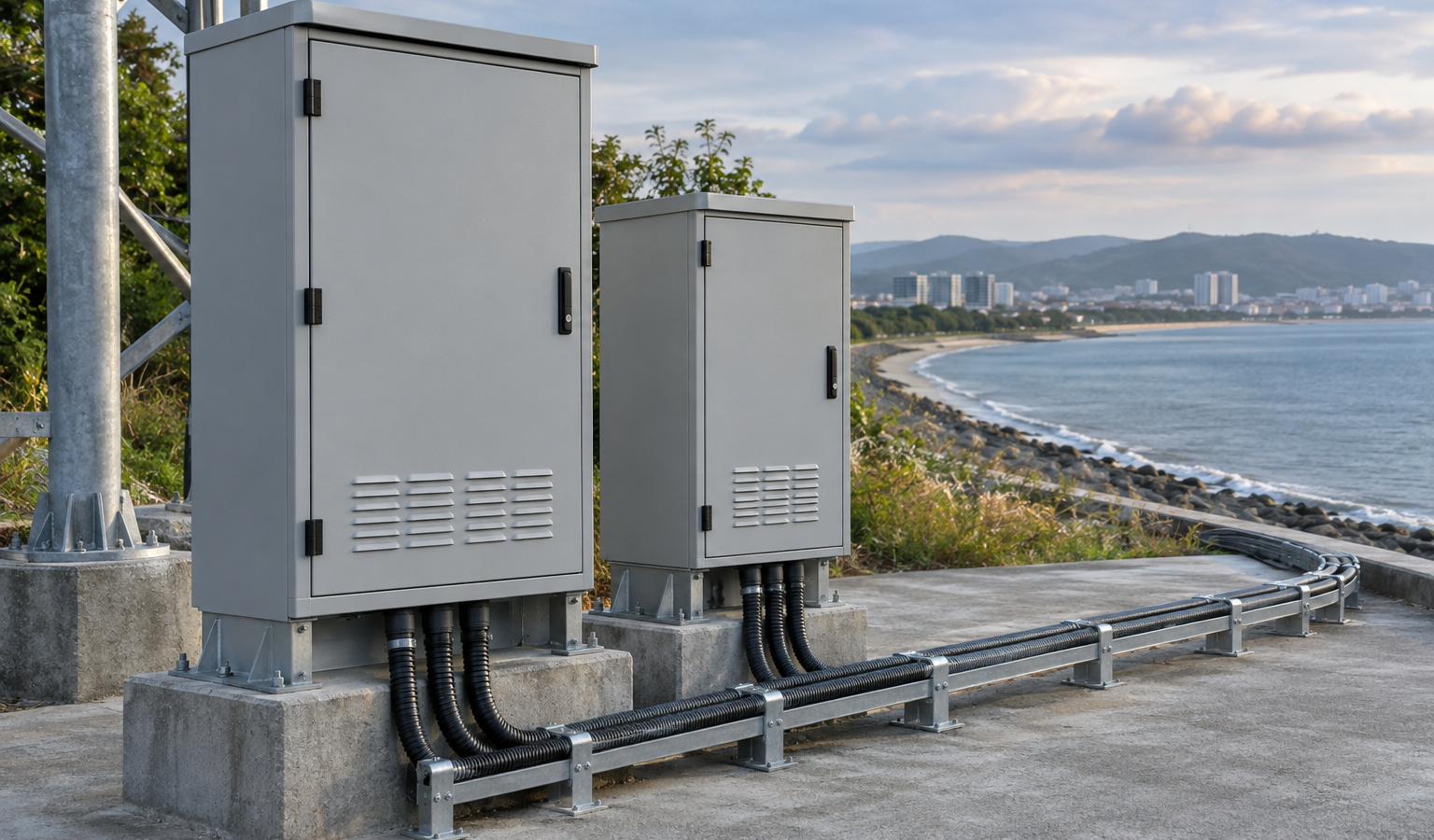
AI-generated illustrative scene; not an ITU event photograph or an Ebocom project.
Network resilience at ITU PP-26 moved beyond keeping individual networks operational to maintaining services through disruption. At a session held on 10 November 2026, ministers and industry representatives discussed the dependencies connecting terrestrial, submarine and satellite networks with cloud and data-centre infrastructure.
ITU reported the discussion on 11 November in “Network resilience: Design for disruption”. Its account highlights diversified cable routes, infrastructure redundancy and cross-border planning. For fibre buyers, the distinction is practical: a cable can meet its material specification while the service still depends on one vulnerable route.
Network resilience at ITU PP-26: the service comes first
The official session programme listed the discussion for 14:30–17:30 on 10 November at DECC, Meeting Room D. It framed resilience around combined threats including extreme weather, power failures, cyberattacks and disruptions affecting subsea and satellite systems.
The programme also identified geographic diversity, monitoring, restoration and international coordination as issues created by increasingly interconnected infrastructure. These were discussion themes, not a new product standard or a cable certification scheme.
In ITU’s post-event account, Saint Vincent and the Grenadines described the communications consequences of Hurricane Beryl in July 2024. The country is assessing critical infrastructure and working with Grenada on a submarine cable project incorporating satellite backup. The example concerns network recovery and complementary systems; it is not an Ebocom project.
Ebocom perspective: separate two routes on the drawing
Consider a hypothetical campus with two fibre cables between the same buildings. If both enter through one duct and the same access chamber, a second cable alone does not demonstrate two independent physical paths. The question for the network designer is which failures both links still share. This is an editorial illustration of the issue, not a finding about a particular installation.
For the material enquiry, give each proposed route its own identifier. Retain the route-specific installation conditions and required continuous cable lengths. That helps distinguish a request for additional fibre capacity from a request serving a separate physical path. An armour option, fibre count or cable model cannot settle the network’s resilience architecture by itself.
Ebocom’s outdoor route-to-RFQ checklist and drum-schedule guide can support that material handoff. They address the supply information needed after the project team has identified its routes; they do not calculate service availability or guarantee recovery time.
Keep the policy discussion and purchase specification distinct
The lesson for a procurement file is to preserve the reason for each cable run. Label a spare, replacement or separate-route requirement accurately, then attach the relevant specification. The 10 November discussion does not create an “ITU resilience-approved” cable designation.
For an Ebocom material quotation, send the route references, fibre count, lengths and destination through the contact form or to leo@yibocable.com. Your spec, quoted in 12 hours.